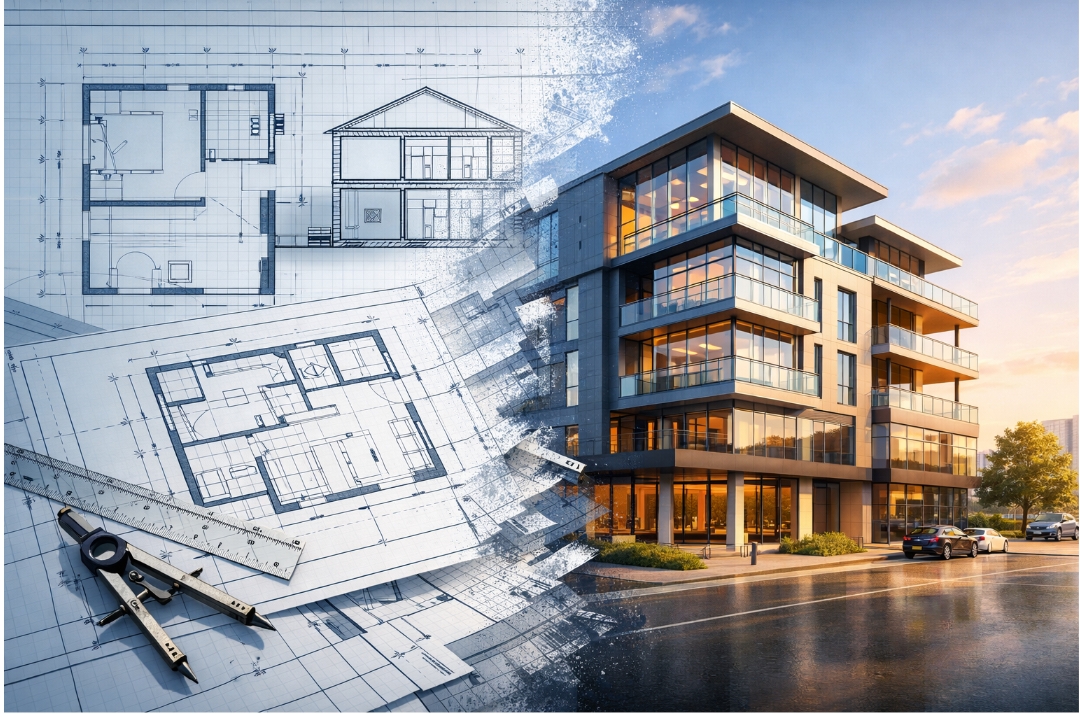
Every building project begins long before construction crews arrive on site. The drafting method chosen at the design stage shapes how ideas are communicated, how accurately elements are built, and how efficiently teams collaborate. Whether working on a small commercial renovation or a multi-story residential development, the decision between 2D and 3D drafting has long-term implications for cost control, coordination, and construction outcomes.
2D drafting has been the backbone of construction documentation for decades. In recent years, 3D drafting and modeling have become increasingly common as technology has evolved and project complexity has increased. Understanding how each approach works, where each excels, and where limitations arise allows project stakeholders to select the most effective solution for their specific needs.
Understanding 2D Drafting in Construction
Definition and Core Characteristics
2D drafting represents building elements using flat drawings created on a horizontal and vertical plane. Plans, elevations, sections, and details are produced as individual views, each focusing on a specific aspect of the building. Dimensions, annotations, symbols, and line weights communicate how components are constructed and assembled.
In professional practice, 2D drawings remain the foundation of construction documentation. Contractors rely on them for measurements, material specifications, and compliance with local codes. Many firms that provide cad design services continue to deliver 2D drawings because of their universal acceptance and clarity within the construction industry.
Common Applications and Industries
2D drafting is widely used across architecture, structural engineering, civil works, and MEP coordination. It is particularly common for:
- Residential housing projects with standard layouts
- Tenant improvements and interior fit-outs
- Permit and approval submissions
- As-built documentation for existing structures
Regulatory authorities often require 2D drawings for review, making them essential even when 3D models are used internally.
Advantages and Limitations
The primary advantage of 2D drafting lies in its simplicity and precision. Drawings are relatively quick to produce, easier to revise for experienced drafters, and compatible with nearly all design and construction workflows. Files are lightweight, making them easy to share and archive.
However, 2D drafting requires users to mentally visualize the building in three dimensions by interpreting multiple drawings simultaneously. This can increase the risk of misinterpretation, especially for non-technical stakeholders. Coordination issues may arise when changes in one drawing are not accurately reflected across all related views.
Understanding 3D Drafting and Modeling
Definition and How It Differs from 2D
3D drafting and modeling create a digital three-dimensional representation of a building. Instead of separate views, the structure is developed as an integrated model where walls, floors, roofs, and systems exist in spatial relationship to one another. Plans, sections, and elevations are often generated directly from the model rather than drawn independently.
This approach shifts drafting from line-based documentation to object-based modeling. Each element carries embedded information such as dimensions, materials, and spatial constraints, allowing for more dynamic updates throughout the design process.
Visualization and Coordination Benefits
One of the most significant benefits of 3D drafting is enhanced visualization. Stakeholders can see how the finished building will look and understand spatial relationships without needing to interpret multiple drawings. This clarity supports faster decision-making and improves communication with clients, investors, and approval authorities.
Coordination between disciplines is also improved. Structural, architectural, and MEP components can be reviewed within the same model, helping teams identify clashes early in the design stage. This proactive coordination reduces rework during construction and supports more predictable project outcomes.
Limitations and Learning Curve
Despite its advantages, 3D drafting introduces new challenges. Developing and maintaining a detailed model requires more time upfront compared to producing basic 2D drawings. Software proficiency and standardized modeling practices are essential to avoid inconsistencies.
Additionally, not all projects require the level of detail provided by 3D drafting. For smaller or less complex buildings, the additional effort may not yield proportional benefits. Hardware requirements, file sizes, and data management can also become considerations for teams new to 3D workflows.
Key Differences Between 2D and 3D Drafting
Accuracy and Detail
Both 2D and 3D drafting can achieve high levels of accuracy when executed correctly. In 2D drafting, accuracy depends heavily on the drafter’s attention to detail and consistency across drawings. Coordination errors may occur if updates are missed.
In 3D drafting, changes made to the model automatically propagate across generated views, reducing the likelihood of discrepancies. This integrated approach supports higher consistency, particularly in complex projects with multiple systems and design revisions.
Cost and Time Implications
From a cost perspective, 2D drafting typically requires less initial investment in software, training, and production time. It remains a cost-effective option for straightforward projects with limited design iterations.
3D drafting often involves higher upfront costs due to modeling effort and technical requirements. However, these costs can be offset by reduced construction errors, fewer change orders, and improved scheduling accuracy. Over the full project lifecycle, 3D drafting can deliver value through risk reduction.
Collaboration and Error Reduction
Collaboration in 2D drafting relies on careful coordination between multiple drawing sets. Communication gaps can occur when different teams interpret drawings differently.
3D drafting promotes collaboration by providing a shared visual reference. Conflicts between systems are easier to identify and resolve during design, which significantly reduces errors that might otherwise appear during construction.
Choosing the Right Drafting Approach for Your Project
Project Size and Complexity
Smaller projects with simple layouts often benefit from the efficiency of 2D drafting. Standard residential buildings, minor renovations, and code-compliant layouts can be effectively documented using traditional drawings.
Larger or more complex projects, such as mixed-use developments or facilities with dense mechanical systems, are better suited to 3D drafting. The ability to coordinate multiple disciplines within a single model becomes increasingly valuable as complexity grows.
Budget Considerations
Budget constraints play a significant role in drafting decisions. When design budgets are limited and construction methods are well understood, 2D drafting may be sufficient. It allows teams to focus resources on construction rather than extensive modeling.
Projects with higher budgets and tighter construction tolerances often benefit from 3D drafting. The investment supports better predictability and helps avoid costly corrections later in the project.
Stakeholder Communication Needs
If a project involves stakeholders with limited technical background, 3D drafting provides clearer communication. Visual models help align expectations and reduce misunderstandings early in the design phase.
For experienced construction teams accustomed to interpreting 2D drawings, traditional drafting may remain effective, particularly when supported by clear details and annotations.
Can 2D and 3D Drafting Work Together?
In practice, many successful projects combine both approaches. 3D drafting may be used during conceptual design, coordination, and visualization, while 2D drawings are produced for permits and construction documentation.
This hybrid workflow leverages the strengths of each method. The model supports coordination and decision-making, while 2D drawings provide the legally recognized documentation required on site. When managed correctly, this integrated approach enhances efficiency without overcomplicating the drafting process.
Final Thoughts
Choosing between 2D and 3D drafting is not about selecting a universally superior method. It is about aligning the drafting approach with project goals, complexity, budget, and stakeholder needs.
2D drafting continues to offer reliability, clarity, and cost efficiency for many building projects. 3D drafting delivers advanced visualization, coordination, and long-term value when applied appropriately. Understanding the strengths and limitations of each allows project teams to make informed decisions that support smoother design processes and better construction outcomes.
By evaluating project requirements early and selecting the appropriate drafting strategy, builders, architects, developers, and project managers can reduce risk, improve collaboration, and set the foundation for successful project delivery.
Meta Title:
2D or 3D Drafting? Making the Right Choice for Your Project
Meta Description:
Compare 2D and 3D drafting methods by cost, accuracy, and coordination to choose the right approach for your building project and team workflow.