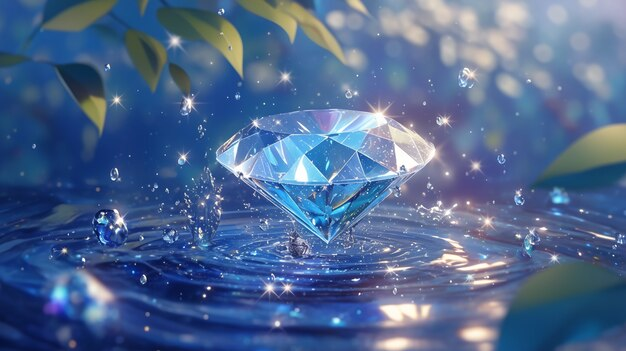
Throughout history, kings and queens have bankrupted treasuries, waged wars, and commissioned elaborate heists to possess a particular type of stone. Not just any diamond would do. They wanted the ones touched by an impossibly rare color, stones that seemed to capture the sky itself within their crystalline depths.
This obsession with blue diamonds isn’t mere vanity. It reveals something profound about human psychology, about how we assign value, about what we choose to represent power and prestige. And whether you realize it or not, the same psychological forces that drove royalty to covet these stones influence your own relationship with rarity and beauty today.
The Psychology of Scarcity
Human brains are hardwired to value scarcity. This isn’t a cultural construct or learned behavior; it’s deeply embedded in our cognitive architecture. Our ancestors survived because they recognized when resources were limited and acted accordingly. A rare food source, a limited water supply, an unusual material: these triggered heightened attention and motivated action.
Blue diamonds represent the ultimate expression of scarcity. They account for less than 0.1 percent of all diamonds ever discovered. For every thousand diamonds pulled from the Earth, perhaps one carries that distinctive azure hue. This extreme rarity triggers powerful psychological responses that transcend culture and time period.
When royalty adorned themselves with blue diamond jewelry, they weren’t just displaying wealth. They were communicating something more fundamental: access to the impossibly rare. In an era when displaying power mattered for survival, for diplomatic negotiations, for maintaining authority, possessing something almost no one else could obtain sent an unmistakable message.
The Color of the Divine
Blue holds unique significance in human psychology and history. Unlike red, yellow, and green, which appear abundantly in nature through flowers, fruits, and foliage, true blue is exceptionally rare in the natural world. Ancient civilizations struggled to create blue pigments, making the color associated with the divine, the royal, and the untouchable.
The Egyptians valued blue so highly they developed artificial methods to create it, grinding lapis lazuli into powder at enormous expense. The Maya created a unique blue pigment used in sacred ceremonies. Medieval European artists paid premium prices for ultramarine, a blue made from lapis lazuli that cost more than gold.
When a stone naturally contains that celestial shade, locked within its crystalline structure, it becomes more than jewelry. It becomes a tangible connection to the sacred, a piece of the infinite made portable. Royalty understood this symbolism intuitively. Wearing a blue diamond meant wearing a piece of the sky, claiming association with the divine right of kings.
The Hope Diamond Legacy
Perhaps no stone better illustrates royal obsession than the Hope Diamond. This 45.52-carat blue diamond has passed through the hands of French kings, British nobility, and American heiresses. Its history reads like a thriller, complete with theft during the French Revolution, mysterious disappearances, and persistent curse legends.
Louis XIV of France acquired the stone in the 17th century, drawn by its exceptional size and color. The diamond became part of the French Crown Jewels, a symbol of royal power and divine authority. When revolutionaries stormed the royal treasury in 1792, the diamond vanished, only to resurface decades later in modified form.
The curse legends surrounding the Hope Diamond reveal how humans create narratives around exceptional objects. When something is that rare, that valuable, we need stories to explain it, to justify the obsession. The curse narrative serves a psychological function: it transforms simple coveting into something more complex, adding layers of meaning to possession.
What This Means for You
Understanding why royalty obsessed over blue diamonds offers insight into your own psychology. When you feel drawn to rare, beautiful objects, you’re experiencing forces that shaped human evolution. When you value scarcity, you’re applying cognitive tools that helped your ancestors survive.
This doesn’t mean you should or shouldn’t desire blue diamonds. It means you can understand that desire as something deeper than simple wanting. It connects you to centuries of human experience, to royalty and commoners alike, all responding to the same fundamental psychological forces.
The next time you see a blue diamond, whether in a museum display or jewelry store window, recognize what’s happening in your mind. You’re not just seeing a pretty stone. You’re experiencing the culmination of billions of years of geological processes and millions of years of evolutionary psychology, all converging in a single moment of recognition and appreciation for beauty and rarity combined.