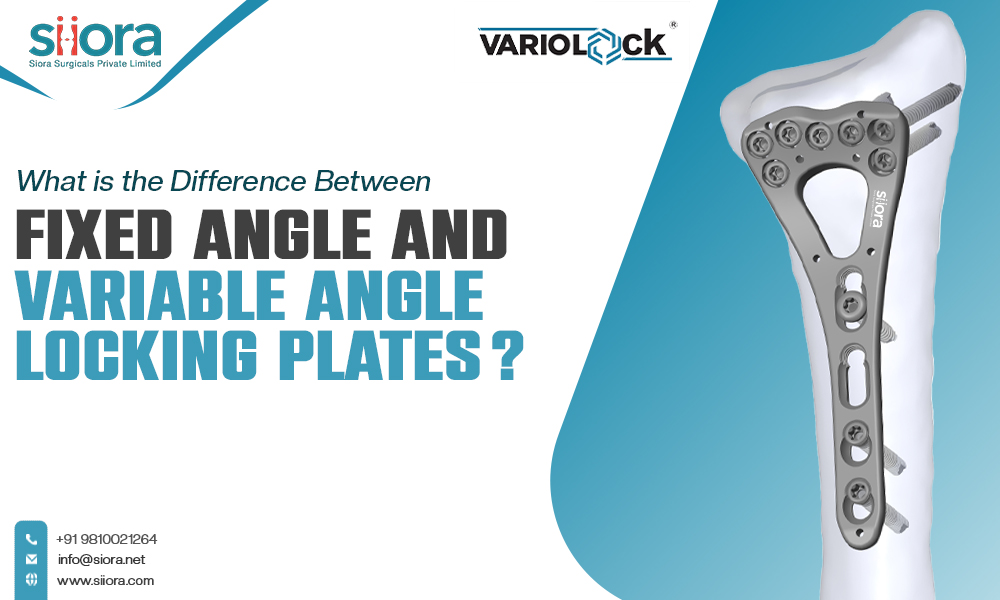
When a bone breaks, the mission is straightforward: realign the pieces and hold them securely so the body can heal. For a long time, the standard approach for surgeons was to use plates and screws. But medical technology is always advancing, and that has brought better tools. The invention of locking plates was a game-changer, creating a much stronger, more solid frame to hold a healing bone in place. This advancement also introduced a critical decision that surgeons now make for each injury: Is a fixed-angle or a variable angle plate the better choice for this specific patient?
Answering that question gets to the heart of how precise modern fracture care truly is. It’s no longer just about getting a bone stable; it’s about creating a custom-fit solution for that person’s anatomy and their particular fracture.
The Workhorse – Fixed-Angle Locking Plates
Think about assembling a piece of pre-fabricated furniture. The holes are already drilled at set angles, and your task is to drive the screws straight in. Fixed-angle locking plates operate on a similar principle. Both the plate holes and the screw heads are threaded. When the surgeon inserts a screw, it locks into the plate at a single, predetermined angle.
This process creates an exceptionally strong, unified construct where the plate and screws function as one solid frame, almost like an “internal fixator.” The benefit here is immense, particularly when dealing with poor-quality or osteoporotic bone. The stability of the repair doesn’t rely on the screw pressing the plate tightly against the bone; instead, it comes from the locked, angularly stable frame itself. For many simple fractures, a fixed-angle plate is the go-to solution because it is strong, dependable, and effective.
The primary drawback, however, is its inflexibility. The surgeon cannot alter the screw’s path. If a pre-set trajectory points toward a joint surface or another fracture line, the surgeon must find a way to work around it. The blueprint cannot be changed.
The Problem-Solver – Variable Angle Locking Plates
This is where the technology evolves. What if you could have the solid security of a locking screw, but with the flexibility to guide it into the perfect position? That is the core concept behind variable-angle plates.
These advanced plates feature a unique design that allows the screw to lock into the plate within a range of angles, usually inside a 15-degree cone. This small window of adjustability is revolutionary. It gives the surgeon the ability to aim the screw slightly up, down, or side-to-side before locking it firmly into its final position.
This flexibility is a surgeon’s best friend in complex situations. For fractures near a joint, known as periarticular fractures, a surgeon can use a variable-angle screw to steer clear of the delicate cartilage. In a complicated break with many small fragments, the surgeon can direct individual screws to capture and stabilize each piece. It allows the hardware to be adapted to the fracture, rather than forcing the fracture to fit the hardware.
Stability Vs. Versatility – Making the Call
So, how does a surgeon decide between the two? It’s rarely a matter of one being universally “better.” It’s about selecting the right trauma implant for the specific task at hand.
A surgeon often picks a fixed-angle plate for breaks in the middle of a long bone, especially if the patient is older and has weaker bone. Because these plates are so rigid, they create a really strong frame for the bone to heal.
On the other hand, a variable-angle plate is the implant for tricky fractures around joints like the wrist, ankle, or knee. This feature gives surgeons the control to create a stable repair while steering screws clear of delicate joint surfaces and other vital areas.
The Last Say
Ultimately, this evolution from fixed to variable-angle plates really shows what modern orthopedics is all about. It’s not enough to just heal the bone anymore; the goal is to put the patient’s anatomy back together perfectly. When surgeons have both tools in their kit, they can handle a wider range of injuries with better results, helping patients get back to their lives sooner.